Project clearing (aka actually finishing something!)
The title refers equally to the clearing of my airways and to the annual tidy-up in parts of the garden! But first we have the completed baffies:
 |
| Trying it on for size. I got the size I wanted by using 2.75mm needles |
 |
| I added 4 rows of grey/red stripes all round after I'd completed the heel section as I wanted some extra height and also I felt it was rather boring without. I wish now that I'd added some stripes to the toe section as well but I'm not going to undo them now! |
 |
| The i-cord bind-off gives a neat finish but the first time I did it was way too tight using 2.75mm needles and I couldn't get my foot in! So I undid it and used 3.5mm needles and worked much more loosely which was perfect. |
 |
| I also made the heel a bit rounder as I didn't like the square effect in the original. To achieve that all I did was knit the 2 centre stitches together on each of 4 rows before the 3-needle bind-off of the heel. |
 |
| Snug feet |
Clearing pests
There are some little critters who share our home without being a nuisance but these pesky ladybirds are not welcome! They aren't the sweet little native ladybirds but are the horrid brutes, aka Harlequin ladybirds, who've been eating them (which I wrote about here).
I read somewhere that they keep coming back to the same places to hibernate because they emit a pheromone or something that attracts fellow ladybirds. Well, it certainly seems to be true as here they are again in exactly the same place even though I washed the whole area to try and clear away any lingering smell from last year.
 |
| I wish the spider could have eaten them so I didn't have to deal with them but she didn't and so I had to remove them. Interestingly, they gave off a really strong smell when I disturbed them. |
All is not well in the barn either as a rat is making its presence felt. I store all the horse feed and bird seed/nuts etc in dustbins with lids but Kizzy's chaff (a feed-mix of chopped straw which I add to bulk up her feed) is not something they eat so it just stays in the sack.
Sometimes I'll find a hole nibbled in the sack where something has explored the sack but has abandoned it as unpalatable. A few days ago that's exactly what happened with just a few bits of chaff around the sack. This morning though the rat had been back again and literally dug about 1/3rd of the contents out of the sack just to annoy me, as rats don't eat chaff!
 |
| Look at the mess! |
 |
| How they got into the sack |
This of course meant a trip to the hardware store for some rat treats (ahem!) which I've placed inbetween the dustbins in the same place as the sack.
Clearing compost, supervised by Tilly, and finding some friends
On Sunday I was feeling much better as my breathflow was only 50 points lower than normal and so Tilly and I headed out into the garden to do some maintenance.
 |
| Tilly inspects the pile of shredded bark/wood which will be used as a mulch on flowerbeds next Spring |
 |
| Just off to inspect the fungi mum….. |
 |
| .…something's had a good feast |
 |
| Watching ducks |
She headed off for an adventure in the wild corner whilst I busied my self elsewhere. This is where we stacked spare slates, concrete blocks/roof tiles and other bits and bobs from when we renovated the house and is teaming with wildlife. I often see lizards and snakes sunning themselves on there and it is a safe haven for newts and invertebrates.
There are also lots of beautiful mosses growing on the terracotta roof tiles.

 |
| Adventure time! |
This is where I was heading; the compost area. I know many of you will skip past this bit but please don't as it's such an important part of gardening. Recycling waste and turning it into something wonderful.
I forgot to take a photo before I started so at this stage I'd already cleared away the butternut squash plant which had been growing on the compost in the bay on the far right. The remaining squashes on there were really small and wouldn't have grown any more so I pulled up the plant and threw it into the bay on the far left.
The plant remaining is a yellow courgette and it still has some viable courgettes forming so I left it to grow a bit longer. It will keep going until the first frosts and I reckon we'll get another batch of courgette fritters out of it. Yum!


The other things I found were some potatoes which had sprouted from some discarded bits that were in the heap. I put them in the sun to dry and firm up their skins.

Now, just look at this beautiful crumbly compost. This was the heap from last year of which I used 1/2 for planting and then left the rest to rot down further to produce this nutrient-rich loam. When I've removed the plant I'll shall store this compost in empty horse-feed sacks (if I manage to save any without rat holes in!) and use it, mixed with some garden soil, for potting next Spring I should add that it doesn't smell.

Then it was time to turn the middle heap onto the end heap. It's jolly hard work but really worth it as it gets more air and water into it which speeds up the rotting process. You can see that the bits that were on the bottom of the middle heap are already quite well rotted and now they're on the top of the heap they'll keep the lower layers nice and warm to speed up the process.

Once the bay on the far right is empty I shall start piling things into there and so the whole process begins again. Until then, Mike will put grass cuttings into the middle section so that I can sprinkle them into the main heap in layers.
I also wanted to check on my Hoverfly Lagoon Project. This was something I got involved with via Sussex University and it was about seeing how many varieties of larvae you could attract using a bucket of water with a dry filling around it for them to pupate.
This is now over and so I wanted to empty out the bucket and tidy up the material around it. I was very careful as I searched through the wood chips and dry leaves as I knew there would be little friends hiding within and I wasn't wrong:
 |
| A beautiful Leopard Slug |
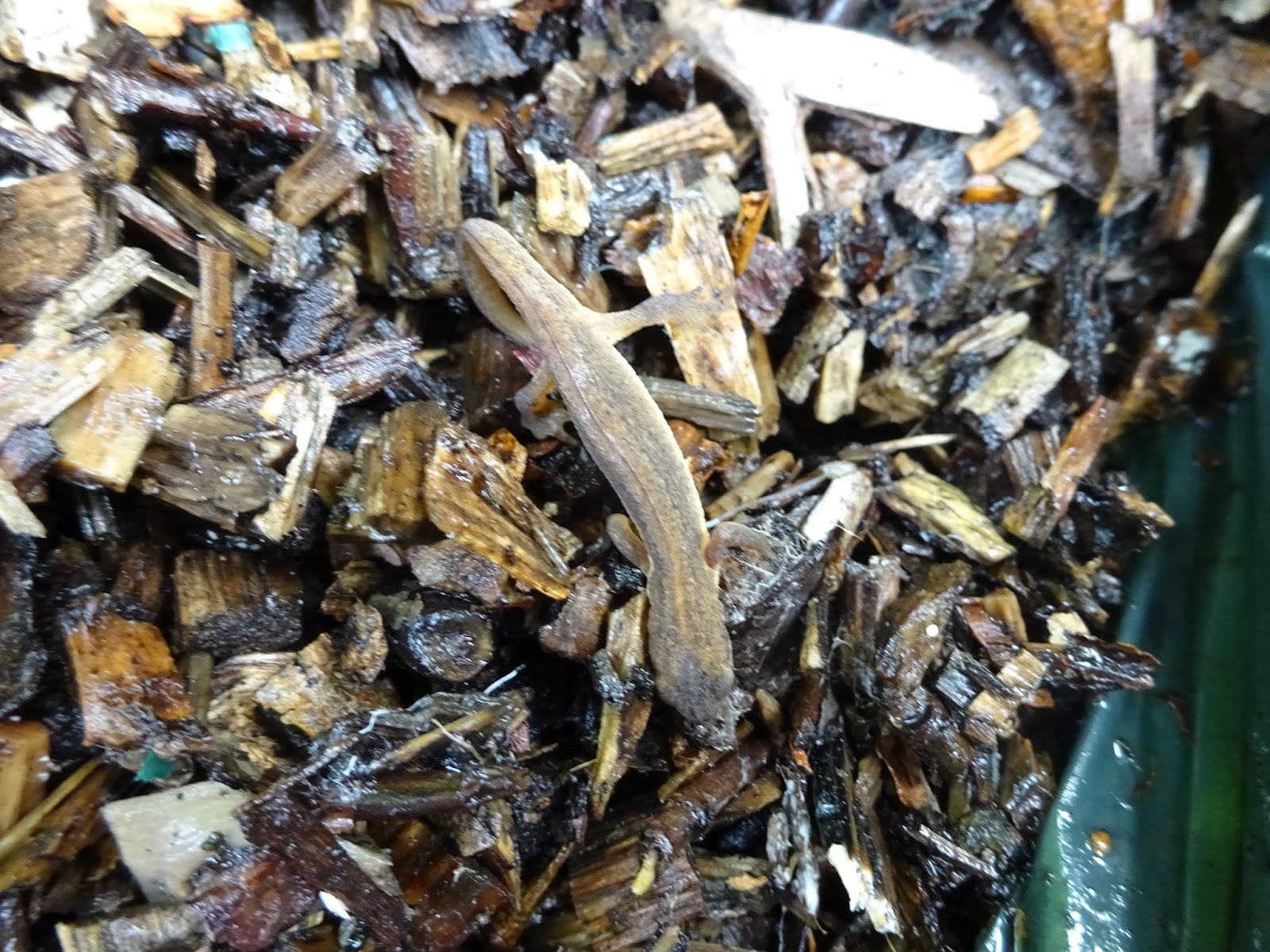 |
| Look how well camouflaged this little newt is |
 |
| I put them in the undergrowth by the hedge so they would be safe |
When we'd finished exploring and compost turning, Tilly and I headed down past the orchard to sit and watch the ducks on the pond whilst having a swing (well, only I sat on the swing, Tilly mooched around in the long grass!).
 |
| I noticed the bright orange seeds of the Iris and remembered why I don't grow it in a more prominent position - the unattractive spots of 'rust' on its leaves, which are not easily controlled, make it a plant for wilder parts of the garden. |
 |
| The colour of Hawthorn berries intensifies as they ripen |
 |
| Now the leaves have fallen from the orchard trees I notice the beautiful lichens growing on the branches |
I have busy weekend ahead of me. On Saturday there's the ARUK Supporters' Day in London which I can only attend for half the day as I need to get home in decent time (the trains are very unreliable at weekends during the upgrade to London Bridge Station) as I shall be up bright and early the next day for my next marathon.
Oh, I nearly forgot. Following a post a while ago in which there was a photo of some rosehips, Glenys contacted me to tell me that when she was a Midwife during the Second World War, rosehip syrup was given to babies as it's such a good source of vitamin C which was in short supply due to rationing! Here's my version of the recipe which you asked for Glenys xxx


